
Arbitration and China’s Global Business

Image: Linnaea Mallette, Shipping Port (Publicdomainpictures.net)
The growing importance of global business to China makes it crucial for the country to show its commitment to recognize and enforce foreign arbitral awards. Since 1987, China has been a contracting state of the New York Convention, which requires each contracting state to ensure that its judiciary recognizes and enforces an arbitral award made in another contracting state, unless such recognition or enforcement would be contrary to the contracting state’s “public policy”, among other exceptions. The convention does not interpret the “public policy” exception. How the Chinese judiciary interprets it directly influences foreign parties’ level of confidence in doing business with China. A recent court case in China sheds light on the interpretation of this exception.
China’s “New Quality Productive Forces”

Image: Mikhail Denishchenko, Production Technology (Publicdomainpictures.net)
Coined by President XI Jinping in 2023, the term “new quality productive forces” is of great significance because related reforms, with reference to various types of investment, have been identified by the Chinese leadership. Key talks given in 1992 by the late reformist leader DENG Xiaoping and select court cases recently released by China help illuminate the meaning of the term. Actions taken by the courts in these cases to support the development of “new quality productive forces” allow investors to better assess related opportunities.
Third Plenary Session & Deterrence of Accounting Violations

Image: Axelle B, Euros Handshake (Publicdomainpictures.net)
“Strengthening the regulation of listed companies” and “improving the mechanism for protecting investors” are among the many reform tasks identified in the widely anticipated decision adopted at the third plenary session of the 20th Central Committee of the Communist Party of China on July 18, 2024. While China’s newly amended Accounting Law may help accomplish these goals, a case decided by the Supreme People’s Court suggests that additional measures are required.
The Future of China’s Real Estate Sector

Image: Petr Kratochvil, Apartment Building Pattern (Publicdomainpictures.net)
How courts in China handle cases involving struggling real estate developers will affect foreign investors’ confidence in the entire Chinese market. The Supreme People’s Court recently highlighted the enforcement of a series of cases involving a real estate developer. These cases provide indications illuminating how courts in China are expected to follow suit to achieve “good political, social, and legal effects”.
Lawsuits Against China’s State-Owned Enterprises & Government Agencies
Images: Kai Stachowiak, Background Wallpaper;
icon0 com, China Flag Themes Idea (Publicdomainpictures.net)
Is there any chance for a private enterprise to win a lawsuit against a state-owned enterprise or a government agency in China? In an apparent attempt to boost confidence in the Chinese market, the Supreme People’s Court of China has signaled an affirmative answer to this question by releasing two court cases. Will the positive treatment of private enterprises, as demonstrated in these two cases, become a norm?
China’s International Relations, Legal Reform, & Taiwan

Image: Dawn Hudson, Globe Watercolour (Publicdomainpictures.net)
U.S. President Joe Biden’s recent meeting with Chinese President XI Jinping has eased the growing tension between the two countries, giving rise to hope that the difficult Taiwan issue will be unlikely to trigger conflict in the near future. This development is in line with the mainstream stance taken by people in Taiwan. The majority of respondents to surveys conducted from 1994 to 2022 have expressed their wish to see Taiwan (a) maintain the status quo and then decide the future at a later date; or (b) maintain the status quo indefinitely. What does this signal to leaders in Beijing? What can be done in the interim?
China’s Economic Recovery and International Commercial Arbitration

Image: sabthai (Shutterstock.com)
China’s release of a Typical Case showcasing how courts in Shanghai recognized and enforced a foreign arbitral award by a special reading of the factual situation involved may help instill more confidence in foreign parties amid China’s efforts to revive its economy. How was this breakthrough ruling made? What are the implications of the ruling?
China & South Korea
Images: Denise Lett;
Africa Studio;
MattiaATH (Shutterstock.com)
In early 2022 (a special year that marks the 30th anniversary of the establishment of China–South Korea diplomatic relations), China released a Typical Case to highlight the country’s recognition and enforcement of a South Korean judgment. Why now? What messages does this send to courts inside and outside China?
China’s Belt and Road Initiative & Legal Reform
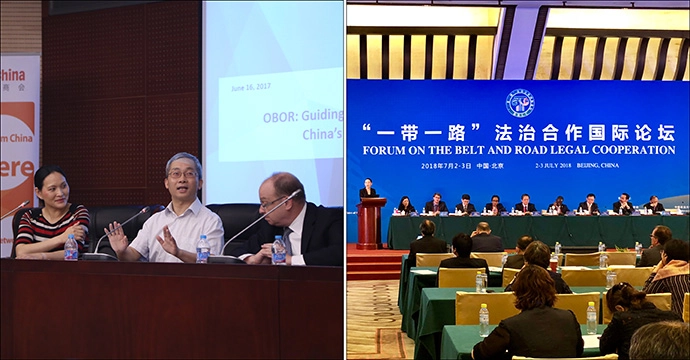
This piece describes how the release of Typical Cases related to China’s Belt and Road Initiative in 2015 ultimately led Dr. Mei Gechlik to make a suggestion at a 2018 international forum organized by the Chinese government […].
Anti-Monopoly Law and Intellectual Property

Image: Den Rise (Shutterstock.com)
Apart from China’s Guiding Cases, legal practitioners, business executives, and other stakeholders must not forget about Typical Cases, another category of representative cases that the Supreme People’s Court of China can release to guide Chinese courts’ adjudication. What are Typical Cases? Why are they significant?